
ONLY ANGELS HAVE WINGS (HOWARD HAWKS, 1939)
Randwick Ritz, Sydney:
2:00 PM
Saturday 09 May
11:00 AM
Monday 11 May
Lido Cinemas, Melbourne:
2:00 PM
Saturday 09 May
11:00 AM
Monday 11 May
Rating: G
Duration: 121 minutes
Country: USA
Language: English
Cast: Cary Grant, Jean Arthur, Thomas Mitchell, Rita Hayworth, Richard Barthelmess
SYDNEY TICKETS ⟶
MELBOURNE TICKETS ⟶
2:00 PM
Saturday 09 May
11:00 AM
Monday 11 May
Lido Cinemas, Melbourne:
2:00 PM
Saturday 09 May
11:00 AM
Monday 11 May
Rating: G
Duration: 121 minutes
Country: USA
Language: English
Cast: Cary Grant, Jean Arthur, Thomas Mitchell, Rita Hayworth, Richard Barthelmess
SYDNEY TICKETS ⟶
MELBOURNE TICKETS ⟶
4K RESTORATION – AUSTRALIAN PREMIERE
‘A completely achieved masterpiece … drawing together the main thematic threads of Hawks’s work in a single complex web.’ – Robin Wood
‘The most amiable great movie ever made.’ – Michael Sragow, The Criterion Collection
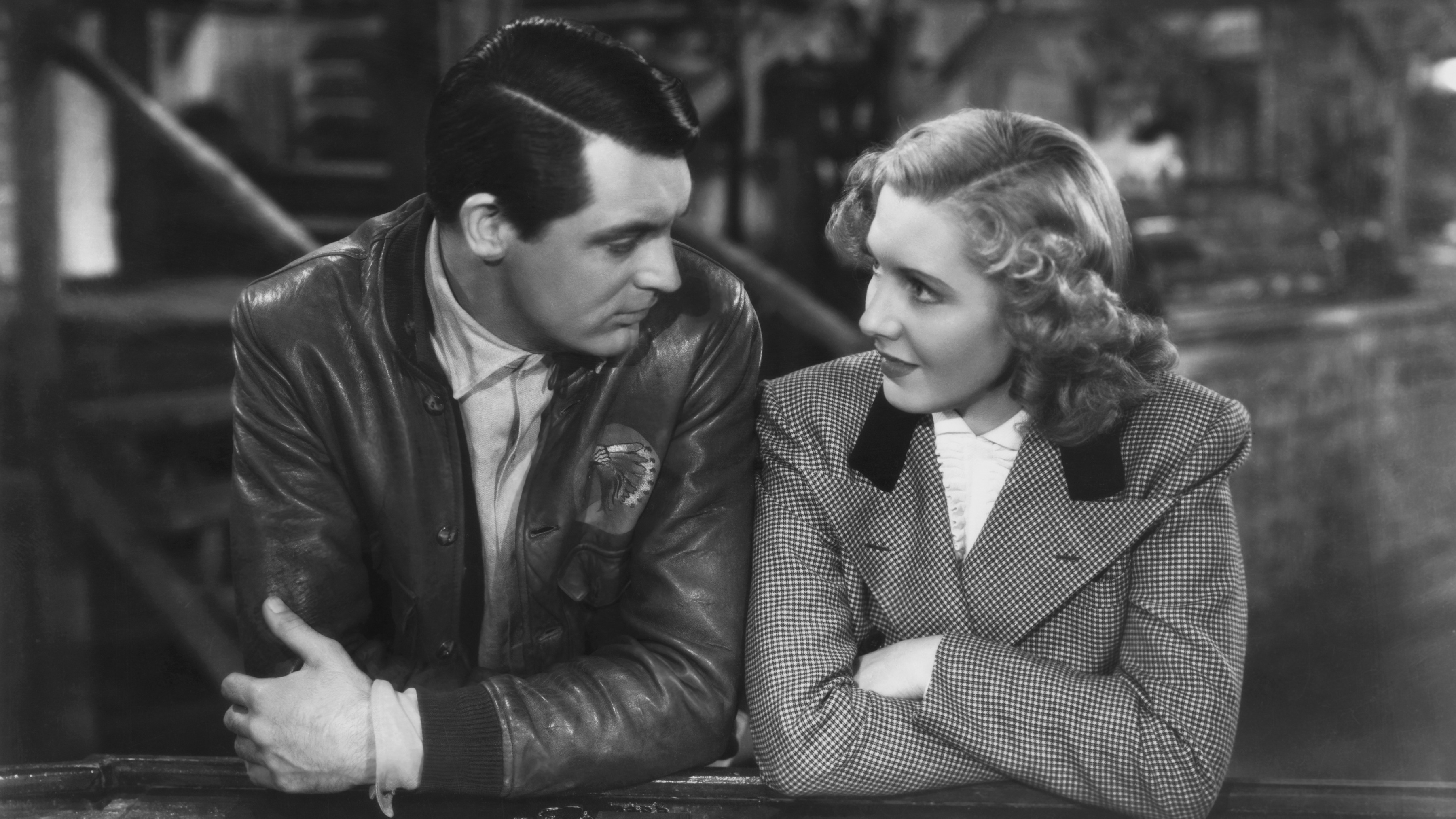
In South America, a group of intrepid pilots led by the laconic Geoff Carter (Cary Grant) navigate treacherous conditions to deliver airmail across the Andes, facing the possibility of death with every flight. Director Howard Hawks drew from his own experiences with aviation in creating this seminal adventure drama, which represents a masterful synthesis of the themes of his 1930s output. Co-starring Jean Arthur as spirited outsider Bonnie Lee – whose emotional openness contrasts with Geoff’s stoicism – alongside Richard Barthelmess and Rita Hayworth in her first major role, Only Angels Have Wings is perhaps the quintessential demonstration of Hawks’s unparalleled ability to balance existential preoccupations with dazzling action sequences, humour and warmth.
Introduced by Virat Nehru at Ritz Cinemas and Kevin Cassidy at Lido Cinemas.
‘A completely achieved masterpiece … drawing together the main thematic threads of Hawks’s work in a single complex web.’ – Robin Wood
‘The most amiable great movie ever made.’ – Michael Sragow, The Criterion Collection
In South America, a group of intrepid pilots led by the laconic Geoff Carter (Cary Grant) navigate treacherous conditions to deliver airmail across the Andes, facing the possibility of death with every flight. Director Howard Hawks drew from his own experiences with aviation in creating this seminal adventure drama, which represents a masterful synthesis of the themes of his 1930s output. Co-starring Jean Arthur as spirited outsider Bonnie Lee – whose emotional openness contrasts with Geoff’s stoicism – alongside Richard Barthelmess and Rita Hayworth in her first major role, Only Angels Have Wings is perhaps the quintessential demonstration of Hawks’s unparalleled ability to balance existential preoccupations with dazzling action sequences, humour and warmth.
Introduced by Virat Nehru at Ritz Cinemas and Kevin Cassidy at Lido Cinemas.
FILM NOTES
By Adrian Danks
By Adrian Danks
Adrian Danks is Associate Professor of Cinema and Media in the School of Media and Communication, RMIT University, and co-curator and president of the Melbourne Cinémathèque.
In many ways, Only Angels Have Wings is the quintessential Howard Hawks movie. Shot between late 1938 and April 1939, it became Columbia Pictures’ third largest box-office success of 1939. Despite drawing on earlier works like The Dawn Patrol (1930), Only Angels is the first Hawks film to fully inhabit the ideal, insular, largely male, romantic and hard-bitten meritocracy that became the director’s comfort zone. Set in a fictional, highly-stylised and idiosyncratically stereotypical South American town, Barranca, a waystation for banana boats nestled between a fog-ridden and oppressively inclement seaport and a vertiginous mountain range, it follows the insanely dangerous exploits of a ragtag group of American pilots charged with flying mail into the country’s interior. The second of Hawks’ films to star Cary Grant – after Bringing Up Baby (1938) – it helped establish Hawks as a bankable Hollywood director and refined the template of situations, relationships, motivations, characters, spaces, places, individual and group philosophies that would mark him out as an identifiable auteur. In Jean Arthur’s “showgirl” Bonnie Lee, it also established the prototype for the “Hawksian woman” – a singular female character who strives to be accepted into a clubby masculine enclave.
Hawks is routinely singled out as an action director who created defining works of the Western, the war film, the gangster film, the screwball comedy, and other genres. But an apparent preoccupation with forward-based movement, action and tight-lipped, hyper-masculine characters doesn’t pinpoint the lasting pleasures, singular achievements and captivating talkiness of Hawks’ greatest work. Only Angels contains brilliantly shot second unit footage of planes flying dangerously close to escarpments, alongside inserted model shots showing close-run take offs, landings and fiery crashes, but much of the film is contained within the cramped, leisurely and utilitarian spaces the group of fliers circulates within. These limited interiors and simulated exteriors were largely shot on the Columbia Ranch in Burbank and grant a potent, strangely lived-in, if highly confected sense of atmosphere and situation. Although the action sequences are engaging, even riveting, they are just gateways to the exchanges between characters. Hawks’ is a gestural cinema – emphasis is placed on the way characters hold themselves, express themselves verbally or are revealed through a repeated action. For example, Grant’s terse character, Geoff never keeps his own matches, preferring to live in the moment rather than prepare for an uncertain future. But this studied, solipsistic and repeated gesture also demonstrates his reliance upon others, a community of like-minded individuals who share an existential philosophy about life’s precarity and the proximity of death.
Hawks’ films often create a kind of utopia. This is a contradictory and ephemeral realm – we are invited to share in a world that values the immediacy of the shared moment. This kind of contract between a film and its audience also defines the filmgoing experience and a certain definition of cinephilia. But although Hawks is often called the quintessential classical Hollywood director – his filmic style often misidentified as “invisible” – his movies have a more leisurely form and style than is common in this “straight corridor” cinema. This approach becomes even more apparent in some of the films that follow Only Angels – think of the jailhouse scenes in Rio Bravo (1959) and how they luxuriate in the spoken, sung and physical exchanges between John Wayne, Ricky Nelson, Dean Martin and Walter Brennan – but we can see its proper emergence here in the dexterous movement from the evasive and indirect mourning of a character’s (‘who’s Joe?’) demise to the effusive group renditions of both ‘Some of These Days’ and ‘The Peanut Vendor’ in one of the film’s great early scenes.
This moment also gives us the first real clue that Bonnie will be able to adapt to this environment and its guiding worldview, when she demonstrates her professional ability to lead and shape both ensemble numbers. This foregrounds another common, misunderstood preoccupation of Hawks’ cinema: the nature of professionalism. Hawks’ films are often set within “work” environments and test the mettle of their characters’ abilities in performing their jobs. But this also becomes a means of dealing with calamity – the casualty rate in Only Angels is plainly unsustainable – encroaching darkness and mortality. This also foregrounds a tension between the present and the past, life and death, actor and character, us and them. The sparkling repartee that is common in Hawks’ work – evident here in screenwriter Jules Furthman’s world-weary romanticism – acts as a means of pasting over the abyss. True feeling is expressed in Only Angels, but it is quickly set aside for a sense of camaraderie and solidarity that can only show its cracks for a moment. But these cracks and moments mean everything.
It may seem ridiculous to call the world created in Only Angels a utopia. The film’s characters live constantly on the edge of death – two fliers die and several others are seriously wounded. Geoff and Bonnie form a couple, but their breathless relationship is forged in the intensity of the moment and a shared understanding of precarity. Although Hawks spoke about the film’s foundation in the documentary reality of the “pilot’s life” – grounded in his own experience and his observations of a group of fliers he met in Mexico – the true pleasure and greatness of Only Angels lie in its sense of invention. Hawks’ films are often at their best when we seem to be just “hanging out” with a group of people we like. There is a deep absurdity to many elements of Only Angels – Cary Grant’s gaucho come flyboy outfit; the absurd coincidences and intensities of the plot; the fetid exoticism of the dreamt-up Barranca setting – and yet this is a world, a room, a bar, an office, a “non-place”, a lookout absurdly perched atop a mountain that I would happily spend the rest of my life in. Who wouldn’t want to hang out with Cary Grant, Jean Arthur, Thomas Mitchell, Sig Ruman, Rita Hayworth (in her breakthrough role), Richard Barthelmess, Victor Kilian and others for eternity or just the few minutes before next perilous mail run?
Hawks is routinely singled out as an action director who created defining works of the Western, the war film, the gangster film, the screwball comedy, and other genres. But an apparent preoccupation with forward-based movement, action and tight-lipped, hyper-masculine characters doesn’t pinpoint the lasting pleasures, singular achievements and captivating talkiness of Hawks’ greatest work. Only Angels contains brilliantly shot second unit footage of planes flying dangerously close to escarpments, alongside inserted model shots showing close-run take offs, landings and fiery crashes, but much of the film is contained within the cramped, leisurely and utilitarian spaces the group of fliers circulates within. These limited interiors and simulated exteriors were largely shot on the Columbia Ranch in Burbank and grant a potent, strangely lived-in, if highly confected sense of atmosphere and situation. Although the action sequences are engaging, even riveting, they are just gateways to the exchanges between characters. Hawks’ is a gestural cinema – emphasis is placed on the way characters hold themselves, express themselves verbally or are revealed through a repeated action. For example, Grant’s terse character, Geoff never keeps his own matches, preferring to live in the moment rather than prepare for an uncertain future. But this studied, solipsistic and repeated gesture also demonstrates his reliance upon others, a community of like-minded individuals who share an existential philosophy about life’s precarity and the proximity of death.
Hawks’ films often create a kind of utopia. This is a contradictory and ephemeral realm – we are invited to share in a world that values the immediacy of the shared moment. This kind of contract between a film and its audience also defines the filmgoing experience and a certain definition of cinephilia. But although Hawks is often called the quintessential classical Hollywood director – his filmic style often misidentified as “invisible” – his movies have a more leisurely form and style than is common in this “straight corridor” cinema. This approach becomes even more apparent in some of the films that follow Only Angels – think of the jailhouse scenes in Rio Bravo (1959) and how they luxuriate in the spoken, sung and physical exchanges between John Wayne, Ricky Nelson, Dean Martin and Walter Brennan – but we can see its proper emergence here in the dexterous movement from the evasive and indirect mourning of a character’s (‘who’s Joe?’) demise to the effusive group renditions of both ‘Some of These Days’ and ‘The Peanut Vendor’ in one of the film’s great early scenes.
This moment also gives us the first real clue that Bonnie will be able to adapt to this environment and its guiding worldview, when she demonstrates her professional ability to lead and shape both ensemble numbers. This foregrounds another common, misunderstood preoccupation of Hawks’ cinema: the nature of professionalism. Hawks’ films are often set within “work” environments and test the mettle of their characters’ abilities in performing their jobs. But this also becomes a means of dealing with calamity – the casualty rate in Only Angels is plainly unsustainable – encroaching darkness and mortality. This also foregrounds a tension between the present and the past, life and death, actor and character, us and them. The sparkling repartee that is common in Hawks’ work – evident here in screenwriter Jules Furthman’s world-weary romanticism – acts as a means of pasting over the abyss. True feeling is expressed in Only Angels, but it is quickly set aside for a sense of camaraderie and solidarity that can only show its cracks for a moment. But these cracks and moments mean everything.
It may seem ridiculous to call the world created in Only Angels a utopia. The film’s characters live constantly on the edge of death – two fliers die and several others are seriously wounded. Geoff and Bonnie form a couple, but their breathless relationship is forged in the intensity of the moment and a shared understanding of precarity. Although Hawks spoke about the film’s foundation in the documentary reality of the “pilot’s life” – grounded in his own experience and his observations of a group of fliers he met in Mexico – the true pleasure and greatness of Only Angels lie in its sense of invention. Hawks’ films are often at their best when we seem to be just “hanging out” with a group of people we like. There is a deep absurdity to many elements of Only Angels – Cary Grant’s gaucho come flyboy outfit; the absurd coincidences and intensities of the plot; the fetid exoticism of the dreamt-up Barranca setting – and yet this is a world, a room, a bar, an office, a “non-place”, a lookout absurdly perched atop a mountain that I would happily spend the rest of my life in. Who wouldn’t want to hang out with Cary Grant, Jean Arthur, Thomas Mitchell, Sig Ruman, Rita Hayworth (in her breakthrough role), Richard Barthelmess, Victor Kilian and others for eternity or just the few minutes before next perilous mail run?
THE RESTORATION
Source: Park Circus
Restored in 4K by Sony Pictures Entertainment. Restored from the 35mm Original Nitrate Picture Negative and 35mm Nitrate Duplicate Picture Negative. Restoration supervised by Grover Crisp.
Director: Howard Hawks; Production Company: Columbia Pictures; Producer: Howard Hawks (uncredited); Screenplay: Jules Furthman, Howard Hawks, William Rankin, Eleanore Griffin (the last three uncredited); based on “Plane from Barranca” by Howard Hawks (uncredited); Photography: Joseph Walker; Editor: Viola Lawrence; Art Direction: Lionel Banks; Costume Design: Robert Kalloch; Music: Dimitri Tiomkin; // Cast: Cary Grant (Geoff Carter), Jean Arthur (Bonnie Lee), Rita Hayworth (Judy MacPherson), Richard Barthelmess (Bat MacPherson), Thomas Mitchell (“Kid” Dabb).
USA | 1939 | 121 mins | 4K DCP | B&W | English | G
Restored in 4K by Sony Pictures Entertainment. Restored from the 35mm Original Nitrate Picture Negative and 35mm Nitrate Duplicate Picture Negative. Restoration supervised by Grover Crisp.
Director: Howard Hawks; Production Company: Columbia Pictures; Producer: Howard Hawks (uncredited); Screenplay: Jules Furthman, Howard Hawks, William Rankin, Eleanore Griffin (the last three uncredited); based on “Plane from Barranca” by Howard Hawks (uncredited); Photography: Joseph Walker; Editor: Viola Lawrence; Art Direction: Lionel Banks; Costume Design: Robert Kalloch; Music: Dimitri Tiomkin; // Cast: Cary Grant (Geoff Carter), Jean Arthur (Bonnie Lee), Rita Hayworth (Judy MacPherson), Richard Barthelmess (Bat MacPherson), Thomas Mitchell (“Kid” Dabb).
USA | 1939 | 121 mins | 4K DCP | B&W | English | G