
HAPPINESS (TODD SOLONDZ, 1998)
![]()
Randwick Ritz, Sydney:
8:00 PM
Saturday 09 May
7:30 PM
Monday 11 May
Lido Cinemas, Melbourne:
8:00 PM
Friday 15 May
7:30 PM
Monday 18 May
Rating: R 18+
Duration: 134 minutes
Country: USA
Language: English
Cast: Jane Adams, Elizabeth Ashley, Dylan Baker, Lara Flynn Boyle, Ben Gazzara, Jared Harris, Philip Seymour Hoffman, Louise Lasser, Jon Lovitz, Camryn Manheim, Rufus Read, Cynthia Stevenson
SYDNEY TICKETS ⟶
MELBOURNE TICKETS ⟶
8:00 PM
Saturday 09 May
7:30 PM
Monday 11 May
Lido Cinemas, Melbourne:
8:00 PM
Friday 15 May
7:30 PM
Monday 18 May
Rating: R 18+
Duration: 134 minutes
Country: USA
Language: English
Cast: Jane Adams, Elizabeth Ashley, Dylan Baker, Lara Flynn Boyle, Ben Gazzara, Jared Harris, Philip Seymour Hoffman, Louise Lasser, Jon Lovitz, Camryn Manheim, Rufus Read, Cynthia Stevenson
SYDNEY TICKETS ⟶
MELBOURNE TICKETS ⟶
4K RESTORATION – AUSTRALIAN PREMIERE
‘The entire cast … is stunningly solid and brave [and] Solondz’s writing and direction [is] first-rate. This is a daring film.’ – Margaret Pomeranz, The Movie Show
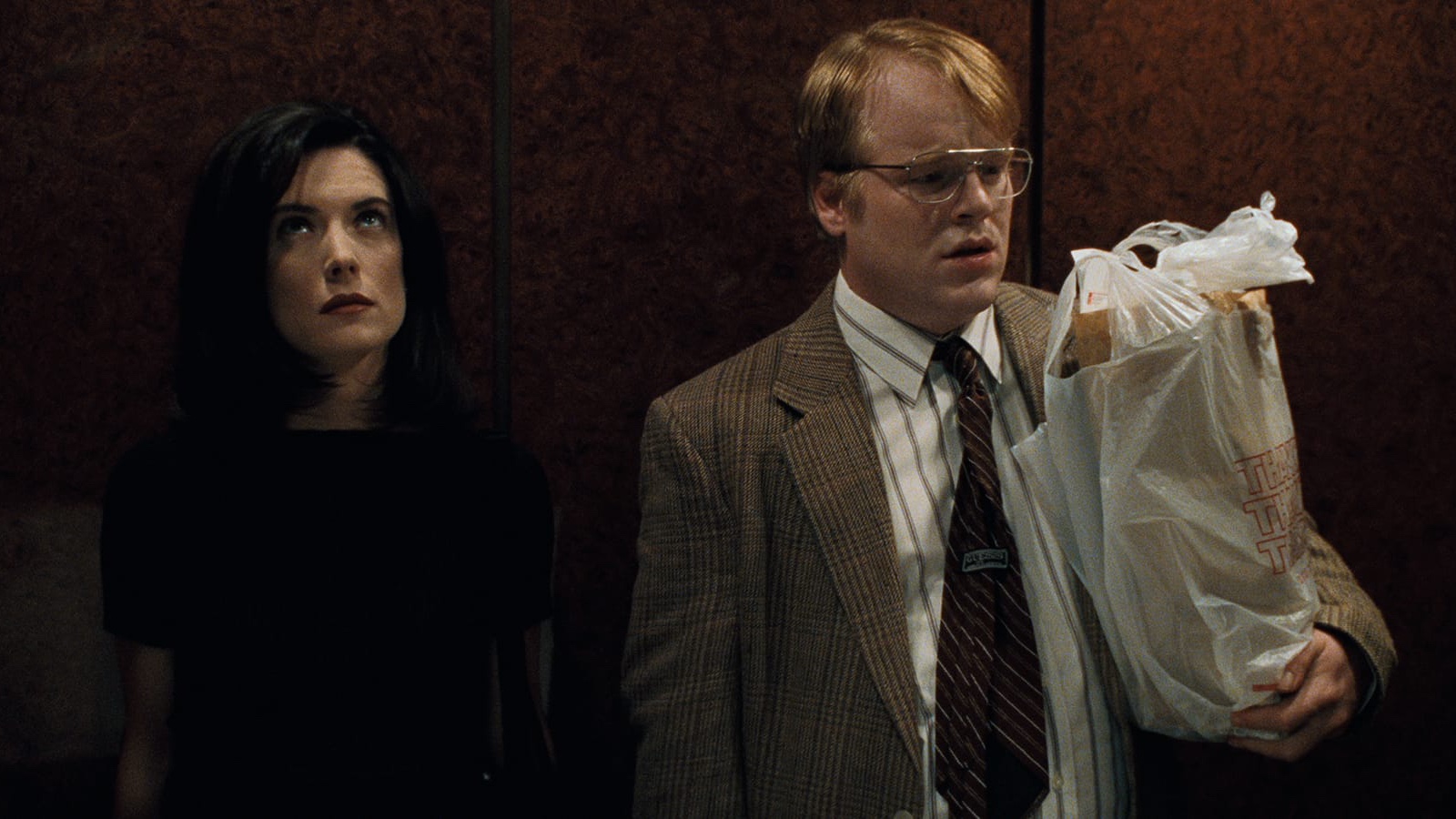
In suburban New Jersey, successful novelist Helen (Lara Flynn Boyle) becomes fixated with the obscene unsolicited phone calls she receives from neighbour Allen (Philip Seymour Hoffman); her sister Joy (Jane Adams) naively believes in the inherent goodness of people but is treated badly by nearly everyone she encounters; and their clean-cut brother-in-law, psychiatrist Bill (Dylan Baker), plays the role of devoted father and husband while harbouring the darkest of secrets.
Todd Solondz pushed black comedy to its limits with this wince-inducing portrait of the sickness at the heart of turn-of-the-millennium white-picket-fence America, which was nominated for Best Screenplay at the Golden Globes and took home awards at Cannes and Toronto. Building an unforgettable melange of wretched yet perversely relatable characters, Happiness is a miserable love letter to humanity at its most abject.
Introduced by Lexi Freiman at Ritz Cinemas and Magic Steven at Lido Cinemas.
‘The entire cast … is stunningly solid and brave [and] Solondz’s writing and direction [is] first-rate. This is a daring film.’ – Margaret Pomeranz, The Movie Show
In suburban New Jersey, successful novelist Helen (Lara Flynn Boyle) becomes fixated with the obscene unsolicited phone calls she receives from neighbour Allen (Philip Seymour Hoffman); her sister Joy (Jane Adams) naively believes in the inherent goodness of people but is treated badly by nearly everyone she encounters; and their clean-cut brother-in-law, psychiatrist Bill (Dylan Baker), plays the role of devoted father and husband while harbouring the darkest of secrets.
Todd Solondz pushed black comedy to its limits with this wince-inducing portrait of the sickness at the heart of turn-of-the-millennium white-picket-fence America, which was nominated for Best Screenplay at the Golden Globes and took home awards at Cannes and Toronto. Building an unforgettable melange of wretched yet perversely relatable characters, Happiness is a miserable love letter to humanity at its most abject.
Introduced by Lexi Freiman at Ritz Cinemas and Magic Steven at Lido Cinemas.
FILM NOTES
By Armani Hollindale
By Armani Hollindale
Armani Hollindale is a writer and filmmaker, owner of the secondhand bookshop Asphalt Books. Editor and board member of Kinotopia newsletter, based in Melbourne.
Armani Hollindale talks with Anne Rutherford about Happiness.
Anne Rutherford: Happiness was a very controversial film when it was first released, with Sundance Film Festival refusing to screen it. Why is it so controversial?
Armani Hollindale: Happiness was and remains a controversial film. The success of Solondz’ previous feature, Welcome to the Dollhouse (1995), at the Sundance Film Festival launched his career, leading to its acquisition and subsequent theatrical release by Sony Pictures Classics. Taking advantage of what he recalls as ‘a momentary blip of value,’ Solondz advanced, unfettered, into the darker realities of an American suburban life. Happiness follows the interconnected lives of three sisters, Joy, Helen and Trish Jordan. Trish’s husband, Bill Maplewood, is a psychiatrist and father, whose responsibilities are thwarted by one violent urge – the sexual attraction to young children. At the centre of this family drama is a film about pedophilia – for Solondz a radical, yet determined exercise in understanding, challenging himself and audiences alike to measure their sympathies with the most repugnant of characters. This was one step too far for Sundance in 1998. The film was deemed ‘morally objectionable’ by the industry, showcasing a perspective on pedophilia that didn’t explicitly condemn it.
Happiness soon after received its deserved critical recognition at Cannes, alongside a notable collection of confronting material in the festival, including Thomas Vinterberg’s Festen (The Celebration, 1998), and Gaspar Noé’s I Stand Alone (Seul contre tous, 1998). These films excited audiences at the time by antagonising respectable cinema and exposing society's spectacle of repression. Nonetheless, the public still tends to focus on the point of controversy, for its provocation endures: navigating the lines of ethical depiction and moral sensitivity of what is, at the end of the day, a horrifying reality and a complex, irreducibly personal lived experience.
AR: You are an enthusiast for the film. What do you like/value about it? Why do you think it merits watching?
AH: The greatest challenge is one of describing this film, because I care about it and yet I still don’t completely understand it. I value the impulse to adjust my perspective; I am never completely settled, uncomfortable with how I may have expressed it and searching for another method of articulating my response. There is a personality in the film which refuses any singular school of thought, contradicting traditional patterns of resolution.
Happiness is an exemplar of fearless ambition, unfettered by the awkward performance of humility in the face of despair. Oblique humour and twisted rhetoric destabilise this film, inviting us to consider the economy of our attention and the passivity of our amusement.
My favourite scene is when Bill Maplewood attends his own psychologist’s appointment. He recalls to the psychologist a dream: taking an assault rifle to a peaceful park, in verdant green. Couples stride hand in hand to an uplifting prelude. The camera follows his armed stroll, as he locks and loads, and fires with a gaze of contentment, before ascending to an overhead shot where he stands in the middle of four sprawling victims at each corner of the frame. Detachment moves from ironic to spatial, forcing an omnipresent observation of violence both surreal and suggestive; for a split second, this could be anyone. Bill is not only stripped of his individuality, but magnified in isolation. The audience is in the position of surveillance and powerless in regard to the scene of violence. Bill says, ‘I wake up happy, feeling good ... but then I get very depressed, because I'm living in reality.’
AR: Solondz seems to choose his material specifically for its transgressive potential. How do you understand what he is trying to do with transgression? How does he think/speak about what he is doing with that approach?
AH: The idea that Solondz chooses material specifically for its transgressive potential is the fundamental misunderstanding of his work, particularly Happiness. When writing a screenplay, he sets out with a scene and allows the characters to dictate the story. Guided by an intuitive decision-making process, Solondz (2005) believes his role as a filmmaker is to ‘access the moment so that nothing is lost upon you … know how to identify and transform moments into something that can take on larger meaning.’ The results of his exploration to the limits of experience are inevitably transgressive.
Happiness is more than a sum of its dejections. Solondz constructs horror from typical moments, reconfigured. Characters’ innermost thoughts are rendered in speech – nothing new in the world of entertainment – winners and losers, humans with misplaced desires, arrogant, lustful, affected, isolated and self-obsessed, repressed by and never able to salvage themselves. Happiness is ambiguous in tone, but not at all flippant. Flawed characters are dissected with meticulous care, revealing an uncanny understanding of the consequences of “pleasure.” He crafts an ideology of the sick, the monster, the tormented, without showing the extreme act of violence. The “shock value” is almost always cast in the viewer's imagination, heightened by private acts of depravity.
Fostered by a suburban adolescence, Solondz deals with the substance of a television hyper-reality, episodic catastrophes and absurd realities, embellished with the foundations of traditional storytelling and classic Hollywood cinema like The Sound of Music. It is precisely this familiar, yet strange surface to which his caustic themes cause friction.
AR: How effective is this approach? Why?
AH: I share with Solondz’ dearest admirers a belief in the merit of mercy – the compassion which must remain in order to understand the source of evil. The discomfort and the confrontation with “the grotesque” succeed in telling us something in the nature of the subject. Viewers are implicated in a moral situation, but the satisfaction of martyrdom is delayed. In this waiting period, the spectator is tasked to evaluate how the crime image registers in the body and the memory. Todd Solondz is stubborn in his direction, so that viewers never have to be compliant with the images of violence. He targets the parts of us unexercised, interrogating our primitive reactions to unconscious fears. The characters are suffering at a safe remove. The child on the television is already an image: framed, mediated, narrativised. Does our moral obligation survive abstraction?
If the cost of looking is one of discomfort, then Happiness is, like a monster, remembered only by the perturbing characteristic of being unable to endure it.
Anne Rutherford: Happiness was a very controversial film when it was first released, with Sundance Film Festival refusing to screen it. Why is it so controversial?
Armani Hollindale: Happiness was and remains a controversial film. The success of Solondz’ previous feature, Welcome to the Dollhouse (1995), at the Sundance Film Festival launched his career, leading to its acquisition and subsequent theatrical release by Sony Pictures Classics. Taking advantage of what he recalls as ‘a momentary blip of value,’ Solondz advanced, unfettered, into the darker realities of an American suburban life. Happiness follows the interconnected lives of three sisters, Joy, Helen and Trish Jordan. Trish’s husband, Bill Maplewood, is a psychiatrist and father, whose responsibilities are thwarted by one violent urge – the sexual attraction to young children. At the centre of this family drama is a film about pedophilia – for Solondz a radical, yet determined exercise in understanding, challenging himself and audiences alike to measure their sympathies with the most repugnant of characters. This was one step too far for Sundance in 1998. The film was deemed ‘morally objectionable’ by the industry, showcasing a perspective on pedophilia that didn’t explicitly condemn it.
Happiness soon after received its deserved critical recognition at Cannes, alongside a notable collection of confronting material in the festival, including Thomas Vinterberg’s Festen (The Celebration, 1998), and Gaspar Noé’s I Stand Alone (Seul contre tous, 1998). These films excited audiences at the time by antagonising respectable cinema and exposing society's spectacle of repression. Nonetheless, the public still tends to focus on the point of controversy, for its provocation endures: navigating the lines of ethical depiction and moral sensitivity of what is, at the end of the day, a horrifying reality and a complex, irreducibly personal lived experience.
AR: You are an enthusiast for the film. What do you like/value about it? Why do you think it merits watching?
AH: The greatest challenge is one of describing this film, because I care about it and yet I still don’t completely understand it. I value the impulse to adjust my perspective; I am never completely settled, uncomfortable with how I may have expressed it and searching for another method of articulating my response. There is a personality in the film which refuses any singular school of thought, contradicting traditional patterns of resolution.
Happiness is an exemplar of fearless ambition, unfettered by the awkward performance of humility in the face of despair. Oblique humour and twisted rhetoric destabilise this film, inviting us to consider the economy of our attention and the passivity of our amusement.
My favourite scene is when Bill Maplewood attends his own psychologist’s appointment. He recalls to the psychologist a dream: taking an assault rifle to a peaceful park, in verdant green. Couples stride hand in hand to an uplifting prelude. The camera follows his armed stroll, as he locks and loads, and fires with a gaze of contentment, before ascending to an overhead shot where he stands in the middle of four sprawling victims at each corner of the frame. Detachment moves from ironic to spatial, forcing an omnipresent observation of violence both surreal and suggestive; for a split second, this could be anyone. Bill is not only stripped of his individuality, but magnified in isolation. The audience is in the position of surveillance and powerless in regard to the scene of violence. Bill says, ‘I wake up happy, feeling good ... but then I get very depressed, because I'm living in reality.’
AR: Solondz seems to choose his material specifically for its transgressive potential. How do you understand what he is trying to do with transgression? How does he think/speak about what he is doing with that approach?
AH: The idea that Solondz chooses material specifically for its transgressive potential is the fundamental misunderstanding of his work, particularly Happiness. When writing a screenplay, he sets out with a scene and allows the characters to dictate the story. Guided by an intuitive decision-making process, Solondz (2005) believes his role as a filmmaker is to ‘access the moment so that nothing is lost upon you … know how to identify and transform moments into something that can take on larger meaning.’ The results of his exploration to the limits of experience are inevitably transgressive.
Happiness is more than a sum of its dejections. Solondz constructs horror from typical moments, reconfigured. Characters’ innermost thoughts are rendered in speech – nothing new in the world of entertainment – winners and losers, humans with misplaced desires, arrogant, lustful, affected, isolated and self-obsessed, repressed by and never able to salvage themselves. Happiness is ambiguous in tone, but not at all flippant. Flawed characters are dissected with meticulous care, revealing an uncanny understanding of the consequences of “pleasure.” He crafts an ideology of the sick, the monster, the tormented, without showing the extreme act of violence. The “shock value” is almost always cast in the viewer's imagination, heightened by private acts of depravity.
Fostered by a suburban adolescence, Solondz deals with the substance of a television hyper-reality, episodic catastrophes and absurd realities, embellished with the foundations of traditional storytelling and classic Hollywood cinema like The Sound of Music. It is precisely this familiar, yet strange surface to which his caustic themes cause friction.
AR: How effective is this approach? Why?
AH: I share with Solondz’ dearest admirers a belief in the merit of mercy – the compassion which must remain in order to understand the source of evil. The discomfort and the confrontation with “the grotesque” succeed in telling us something in the nature of the subject. Viewers are implicated in a moral situation, but the satisfaction of martyrdom is delayed. In this waiting period, the spectator is tasked to evaluate how the crime image registers in the body and the memory. Todd Solondz is stubborn in his direction, so that viewers never have to be compliant with the images of violence. He targets the parts of us unexercised, interrogating our primitive reactions to unconscious fears. The characters are suffering at a safe remove. The child on the television is already an image: framed, mediated, narrativised. Does our moral obligation survive abstraction?
If the cost of looking is one of discomfort, then Happiness is, like a monster, remembered only by the perturbing characteristic of being unable to endure it.
THE RESTORATION
Source: NBCUniversal
Restoration in 4K supervised by Director of Photography, Maryse Alberti with 2.0 surround DTS-HD Master Audio soundtrack.
Director: Todd Solondz; Production Company: Good Machine International, Killer Films; Producer: Ted Hope, Christine Vachon; Screenplay: Todd Solondz; Photography: Maryse Alberti; Editor: Alan Oxman; Production Design: Thérèse DePrez; Costume Design: Kathryn Nixon; Music: Robbie Kondor// Cast: Jane Adams (Joy Jordan), Elizabeth Ashley (Diane Freed), Dylan Baker (Bill Maplewood), Lara Flynn Boyle (Helen Jordan), Ben Gazzara (Lenny Jordan), Jared Harris (Vlad), Philip Seymour Hoffman (Allen), Louise Lasser (Mona Jordan), Jon Lovitz (Andy Kornbluth), Camryn Manheim (Kristina), Rufus Read (Billy Maplewood), Cynthia Stevenson (Trish Maplewood).
USA | 1998 | 134 mins | 4K DCP | Colour | English | R18+
Restoration in 4K supervised by Director of Photography, Maryse Alberti with 2.0 surround DTS-HD Master Audio soundtrack.
Director: Todd Solondz; Production Company: Good Machine International, Killer Films; Producer: Ted Hope, Christine Vachon; Screenplay: Todd Solondz; Photography: Maryse Alberti; Editor: Alan Oxman; Production Design: Thérèse DePrez; Costume Design: Kathryn Nixon; Music: Robbie Kondor// Cast: Jane Adams (Joy Jordan), Elizabeth Ashley (Diane Freed), Dylan Baker (Bill Maplewood), Lara Flynn Boyle (Helen Jordan), Ben Gazzara (Lenny Jordan), Jared Harris (Vlad), Philip Seymour Hoffman (Allen), Louise Lasser (Mona Jordan), Jon Lovitz (Andy Kornbluth), Camryn Manheim (Kristina), Rufus Read (Billy Maplewood), Cynthia Stevenson (Trish Maplewood).
USA | 1998 | 134 mins | 4K DCP | Colour | English | R18+